
The Trillion-Dollar Conversation No One’s Having
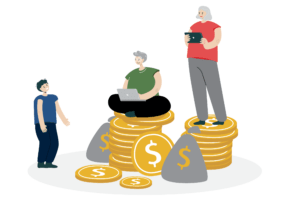
Over the next few years, Canadian baby boomers will pass down roughly $1 trillion to their children. It’s the largest intergenerational wealth transfer in Canadian history.
You’d think something this significant would spark all kinds of family conversations. Planning sessions. Clear discussions about what’s coming and what it means.
But here’s what’s actually happening: silence.
According to recent surveys, less than half of boomers who plan to leave an inheritance have an estate plan in place. And about a quarter haven’t even mentioned their plans to the people who will receive it.
Meanwhile, their kids are making assumptions that might be wildly off base.
The Expectations Gap
Here’s where things get interesting.
Boomers who plan to leave their entire Estate to their children expect to pass down an average of about $940,000. That’s life-changing money for most families—enough to pay off a mortgage, make a down payment, or completely reshape someone’s financial future.
Millennials, on the other hand, expect to inherit around $309,000.
Even if you account for splitting inheritances between siblings, there’s still a massive gap between what parents plan to give and what kids expect to receive. Someone’s going to be surprised—and surprises in Estate Planning rarely go smoothly.
Why the Silence?
So why aren’t families talking about this?
The reasons vary, but they’re all deeply human. Some parents are uncomfortable discussing money in general. Others don’t want to think about their own mortality. Many worry that if their kids know an inheritance is coming, they’ll stop working hard or planning for their own futures.
And then there are the difficult conversations nobody wants to have—like when one child is getting more than another, or when the family cottage is going to one person but not the others.
It’s easier to avoid the conversation altogether. But avoiding it doesn’t make the questions go away. It just means someone else will have to answer them later, without you there to provide context.
What Happens Without the Talk
When inheritance plans aren’t discussed, families are left guessing.
Millennials who expect to inherit are already making financial decisions based on money they hope is coming. Over half say they’re counting on an inheritance to meet their financial goals. They’re planning to use it for retirement savings, housing costs, or paying down debt.
But what if their expectations don’t match reality? What if the cottage they’re counting on has a massive tax bill attached? What if their parents need that money for long-term care? What if Mom and Dad’s plan was completely different from what they assumed?
Without conversation, people make plans in the dark. And when the lights finally come on, the disappointment—or confusion—can damage relationships that were already under stress.
The Tax Surprises Nobody Sees Coming
Here’s another complication that catches families off guard: Canada doesn’t have an inheritance tax, but that doesn’t mean there are no taxes.
When someone dies, the government considers them to have “sold” all their assets at fair market value. If those assets have gone up in value—and let’s be honest, if you bought a cottage or investment property decades ago, they probably have—the Estate will owe capital gains tax.
Sometimes a lot of it.
That family cottage your parents bought in the ’80s for $200,000? If it’s worth $1.2 million today, the Estate could face a tax bill in the hundreds of thousands. If there isn’t enough cash in the Estate to cover it, assets might need to be sold just to pay the taxes.
This is the kind of thing that blindsides families who thought inheriting property would be straightforward. And it’s exactly the kind of issue that can be planned for—if people actually talk about it ahead of time.
It’s Not Just About the Money
Beyond the numbers, there’s something else at stake: understanding.
When parents don’t explain their Estate decisions, kids are left to interpret them on their own. Why did Dad leave the business to one child but not the others? Why is the house going into a trust? Why did Mom set things up this way instead of splitting everything equally?
Without context, people fill in the blanks—and they don’t always fill them in generously. Silence can look like secrecy. Unequal distributions can feel like favouritism. Complicated structures can seem unfair.
Even when parents have perfectly good reasons for their decisions, those reasons die with them if they’re never shared.
What Makes the Conversation Easier
Talking about inheritance doesn’t have to be a single, heavy sit-down conversation. It can happen in pieces, over time, as part of broader discussions about life and the future.
Some families start by sharing basic information: “We’ve updated our Will, and here’s who we’ve named as executor.” Others use specific moments—like selling the family home or updating an Estate Plan—as natural openings to talk about what’s coming.
The goal isn’t to share every financial detail or justify every decision. It’s to give the people you care about enough information so they’re not left guessing. So they know what to expect. So they understand the thinking behind your choices.
And critically, so they know what’s expected of them—whether that’s serving as executor, managing a family business, or simply understanding that the inheritance might be smaller (or larger) than they thought.
The Executor Question
One specific conversation worth having early: who you’ve named as executor, and what that actually involves.
Being an executor today isn’t a ceremonial role. It’s administratively complex, emotionally demanding, and can take months or even years to complete. Executors manage professionals, coordinate family members, file taxes, make decisions that carry personal liability, and navigate all of this while grieving.
If someone doesn’t know they’ve been named, or doesn’t understand what’s involved, they’re walking into a significant commitment blind. Some people might need to decline. Others might want to prepare. Either way, they deserve to know.
Starting Small
If having “the big talk” feels overwhelming, start smaller.
Let your family know you have an Estate Plan and where the documents are kept. Mention who you’ve named as executor and Power of Attorney. Share your wishes around medical care or funeral arrangements.
These aren’t morbid conversations. They’re practical ones. And they’re far easier to have when everyone’s healthy and the decisions feel theoretical, than when someone’s in crisis and the decisions are urgent.
You don’t need to reveal every detail of your finances or justify every choice. But giving your family a roadmap—even a rough one—makes their lives significantly easier when the time comes.
The Bottom Line
A trillion dollars is moving between generations in Canada right now. Some families will navigate it smoothly. Others will struggle with surprises, tax bills, and hurt feelings that could have been avoided.
The difference usually isn’t the size of the estate or the complexity of the plan. It’s whether people talked about it.
Estate Planning isn’t just about documents. It’s about clarity. And clarity requires conversation—even when the conversation feels uncomfortable.
Because the people you leave behind deserve more than guesswork and assumptions. They deserve to understand your intentions, your reasoning, and what you hoped for them.
And the only way they’ll know is if you tell them.
Ready to start the conversation with a clear, complete Will?
SmartWills makes it easy to create a plan that works for your family—and gives you the confidence to talk about what’s in it. Contact Peter with your questions.
Want more information?
Are you interested in a consultation with Peter R. Welsh?
Contact me at Peter@SmartWills.ca
By telephone 416-526-3121
Register for our blog to get valuable tips and up-to-date alerts.
This material is for general information and educational purposes only. Information is based on data gathered from what we believe are reliable sources. It is not guaranteed as to accuracy, does not purport to be complete and is not intended to be used as a primary basis for investment decisions.